The way we understand preparedness says something about how we understand uncertainty, and how ready we are when inevitable change comes suddenly.
Download the full article, including description of the Preparedness Competence Model

Download the graphic scheme of the Preparedness Competence Model
Read an inspiring article from one of the participants
Before you read on…
You may wonder whether preparedness is relevant to transnational youth work.
When we introduced preparedness into the non-formal, international youth education field, we met a wide range of reactions. At one end, some people fully understood it and felt it was essential, noting that it had always been present in youth work and international training. At the other end, some people claimed that preparedness would lay a sense of insecurity over non-formal education, bring daily visions of catastrophe, and evoke associations with the military.
Wherever your own opinion sits on this spectrum, we invite you to read this article. Perhaps this story will open up a new understanding of what readiness beyond can mean.
What does being prepared mean to you personally?
When you hear the word preparedness, what is the first image that comes to your mind?
- A backpack packed and ready to go?
- An evacuation plan?
- Knowing where to find reliable information?
- Someone who stays calm when everyone else is overwhelmed?
- Or perhaps something much quieter: knowing yourself well enough to recognise when you
- are reaching your limits,
- knowing who you can turn to,
- and being able to make a decision when there is no perfect answer?
- anything else?
There is no one right answer here…
Why are we talking about Preparedness now?
For a long time, preparedness had often been associated with emergency services, safety procedures, risk assessments and emergency equipment. These things still matter. But the world we are preparing for is becoming increasingly difficult to describe through one emergency, one risk or one plan.
We live in a time of overlapping disruptions: geopolitical tensions and war, climate-related events, public health crises, technological and cyber risks, information manipulation, displacement and social polarisation. These situations do not always arrive one at a time. They can overlap, influence one another and change faster than our plans can.
The term “policrisis” has become an everyday concept, mentioned at the policy level, in the media, and in regular meetings among random people. The European Union has responded to this changing landscape by placing preparedness much more visibly on the European agenda. The 2025 Preparedness Union Strategy describes preparedness as an all-hazards and whole-of-society effort and explicitly includes education, training and youth programmes within the wider preparedness landscape. This shift matters.
“Because if preparedness belongs to everyone, it cannot belong only to emergency professionals.”
- It also belongs to communities.
- To organisations.
- To educators.
- To volunteers.
- To youth workers.
- To us, the trainers, facilitators or young leaders who create spaces where others learn, connect and act together.
“Preparedness is not only about what happens out there”. Imagine something serious happens during an international youth activity.
- How do you react?
- How do the young people in your group react?
- What about the wider context: the people around you, the location, the way decisions are made?
- What happens when the original plan no longer works?
“At that moment, preparedness is not simply a checklist.”
- It is also the ability to notice what is happening inside yourself while remaining available to others.
- It is knowing how stress affects your attention and decision-making.
- It is recognising your limits before you reach exhaustion.
- It is being able to regulate yourself enough to think clearly. It is knowing how to offer psychological first aid without taking control away from others.
It is also relational.
How do you listen when you are under pressure? How do you build trust before a crisis happens? How do you communicate clearly when information is changing? How do you work across cultural differences and include people whose voices may easily be missed?
And we are describing a situation from a perspective of wholeness – which means it is systemic.
How do you distinguish what you know from what you assume? How do you understand the wider context? How do you recognise early signs of escalation? How do you connect local action with the larger systems and structures around you?
The Preparedness Competence Compass
This Competence Model, developed during the first edition of the Preparedness Workshop in the Polish mountains, brings these dimensions together. It describes preparedness through four interconnected areas:
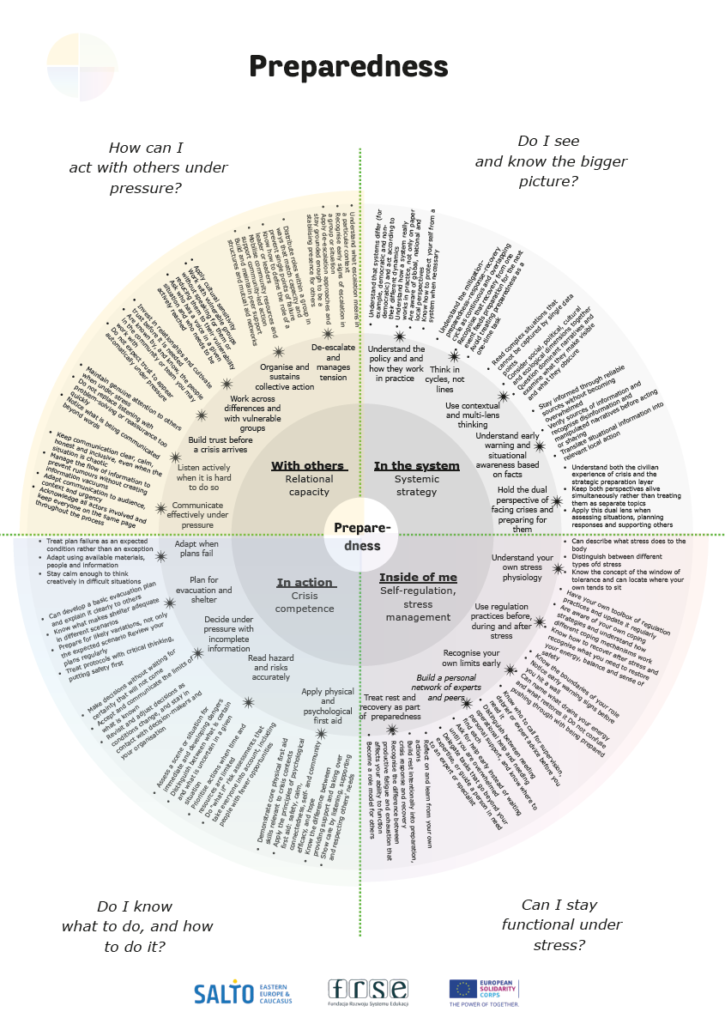
They are not four separate quadrants. They are four ways of looking at the same question:
How can we remain capable of responding when the situation becomes uncertain?
This article begins from the belief that preparedness does not start when the crisis arrives.
- It starts much earlier.
- In the way we know ourselves.
- In the relationships we build.
- In the questions we ask.
- In the systems we map and navigate.
This article is not intended to give you the answer to preparedness. It invites you into a process of discovery.
TOP Workshop that started it all
Five days of learning to meet uncertainty, where a competence model could be designed and elaborated around a table.
“Preparedness, however, is harder to understand while sitting still and talking about it”.
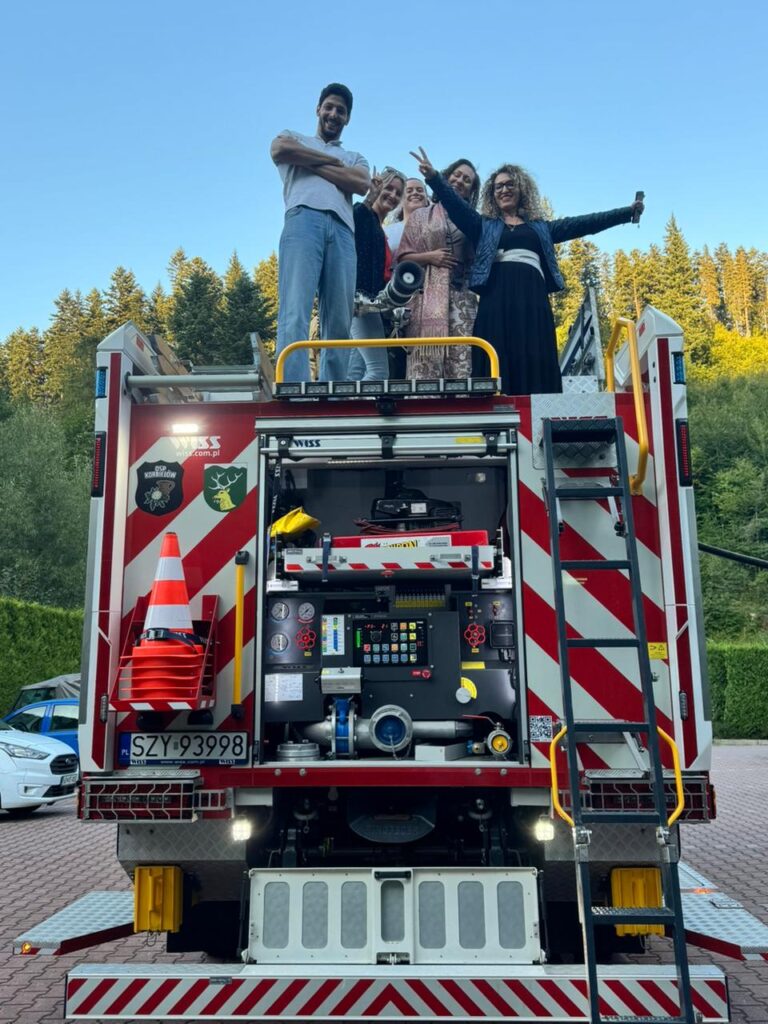
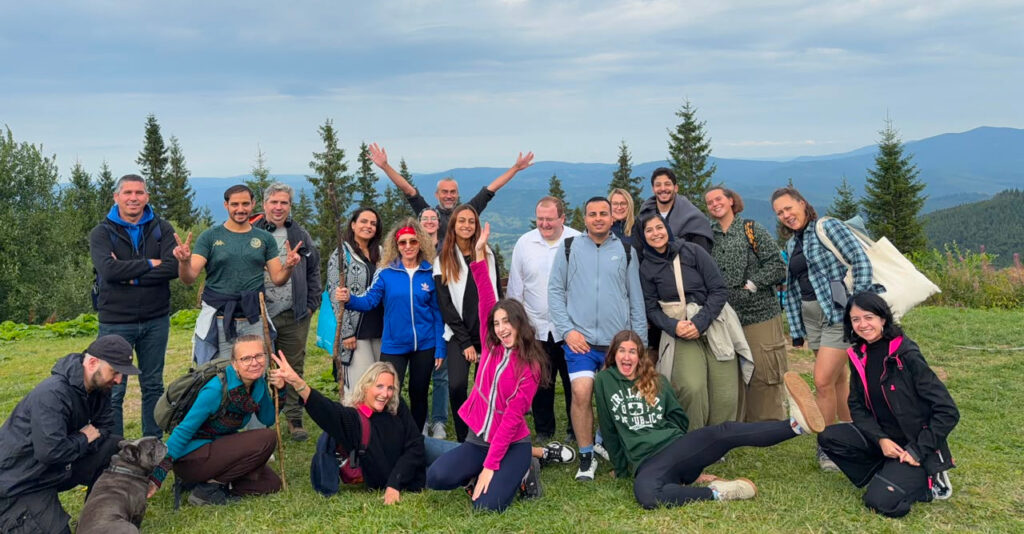
It needs to be experienced: in the body, in relationships, in decisions, in changing environments and sometimes in situations where the plan simply stops working. From 24th to 29th August 2026, 16 participants, two trainers, two representatives of the SALTO Eastern Europe and Caucasus and one officer of the Polish National Agency of the European Solidarity Corps came together in Korbielów, Poland, surrounded by the Beskid Żywiecki mountains.
The training brought together trainers working with European Solidarity Corps volunteers, project coordinators, youth workers, mentors etc., coming from Programme and Partner countries (Armenia, Italy, Belgium, Tunisia, Poland, Georgia, Ukraine, Greece, Egypt, Germany). The deliberate diversity of the group meant that different experiences, systems and understandings of crisis entered the same learning space.
The training was facilitated by Dagna Gmitrowicz and Mariia Herashchenko, with the organisational support from Anna Hryshkevych, Agency Agnieszka Jankiewicz-Kiryk and Tomasz Szopa. Its purpose was not to give participants another checklist to complete. From the beginning, the invitation was different:
This is not a course about ticking the “preparedness” box.
Instead, participants were invited to ask uncomfortable questions, challenge assumptions and explore what it means to be ready – and how trainers and youth workers can help build a culture of preparedness among young people, volunteers and local communities. And so, the journey began.
The Tangible and the Imaginary Dragons entered the room
Two dragons appeared.
One represented the real moment, the real danger (the fire has started, the storm has arrived, the war has broken out, the volunteer calls for help, …)
The other dragon lives in our imagination. It whispers, “What if something terrible happens?” and “What if I fail?” Often this dragon triggers a stress reaction in a moment of peace. Sometimes it protects us by helping us prepare; sometimes it makes us fight battles that never come. Between these two dragons lies the whole kaleidoscope of our emotions: EASE, CURIOSITY, ALERTNESS, TENSION, ANXIETY, FEAR, PANIC.
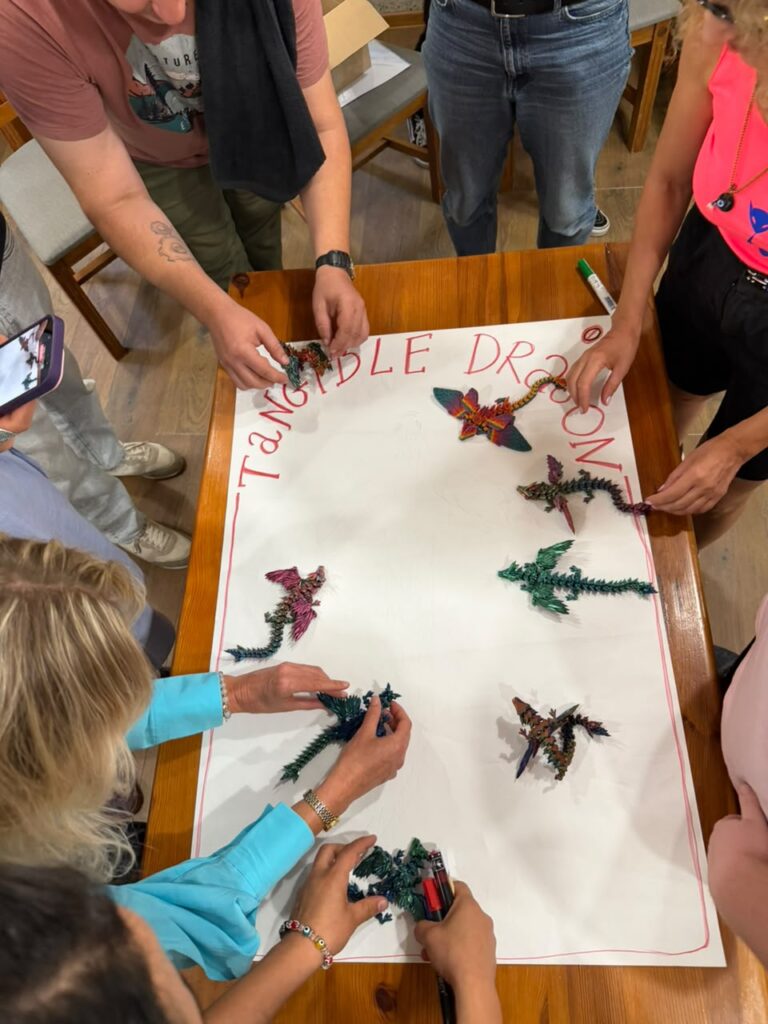
‘No matter the Dragons’, people can experience this whole spectrum; even in the same situation, different people experience different emotions. In this training, we were trying not to defeat the dragons but rather to recognise which dragon was walking beside us, to notice what’s happening inside us, to understand how uncertainty influences our decisions and how to develop a competence to respond wisely.
Participants created these two dragons together, asking themselves:
- What is alive when this or that dragon comes to my mind?
- What emotions travel with it?
- What happens in our bodies when it appears?
- Who are these dragons in our lives and in our communities?
The dragons were deliberately playful. They allowed something serious to become visible without immediately needing to solve it. And they stayed with us. The following days repeatedly returned to the question:
How can we learn to walk beside our dragons rather than be overwhelmed by them?
This became an important shift in our understanding of preparedness.
“Preparedness is not only about controlling what is outside us. It begins with recognising what is happening inside us.”
On the paths of dragons
From body to action
The second day of the workshops moved into stress physiology, regulation practices, embodiment and sensory awareness. We explored what stress does to the body and mind, the window of tolerance, grounding and breathing, and the difference between being able to push through something and actually being prepared.
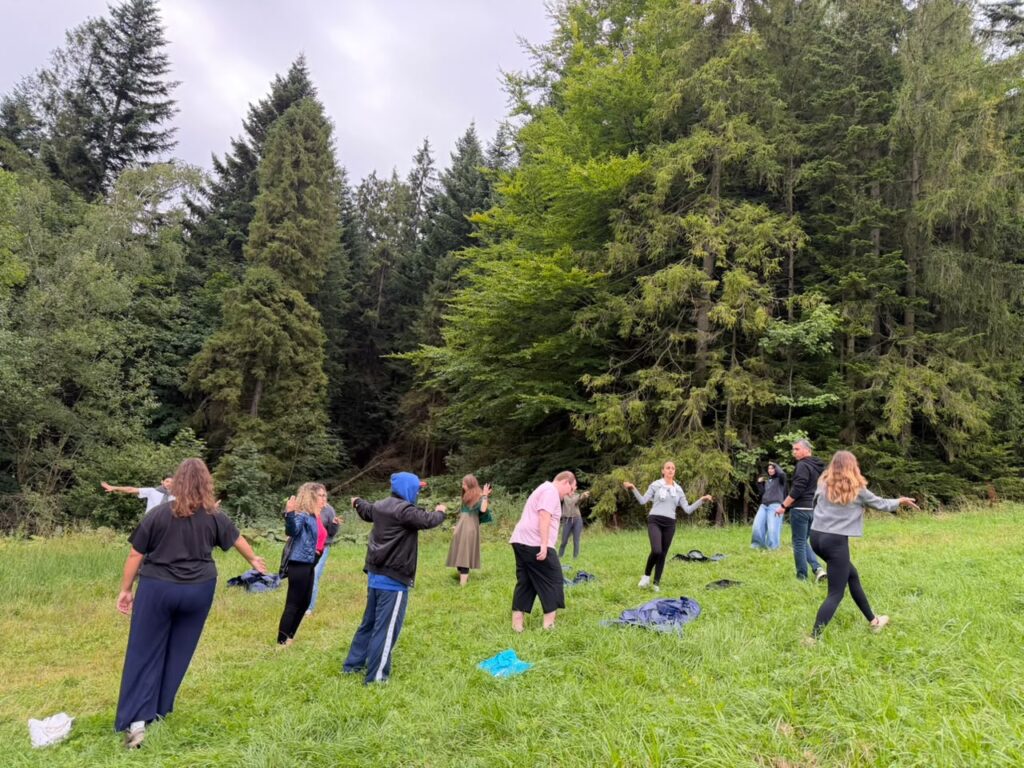
This gave the first dimension of the emerging model a very human starting point: INSIDE OF ME.
Can I stay functional under stress? The model describes this as self-regulation and stress management: understanding our stress responses, using regulation practices, recognising our limits and treating rest and recovery as part of preparedness. But the training did not allow us to stay inside ourselves for too long. Preparedness eventually has to become action.
The mountains became our learning space
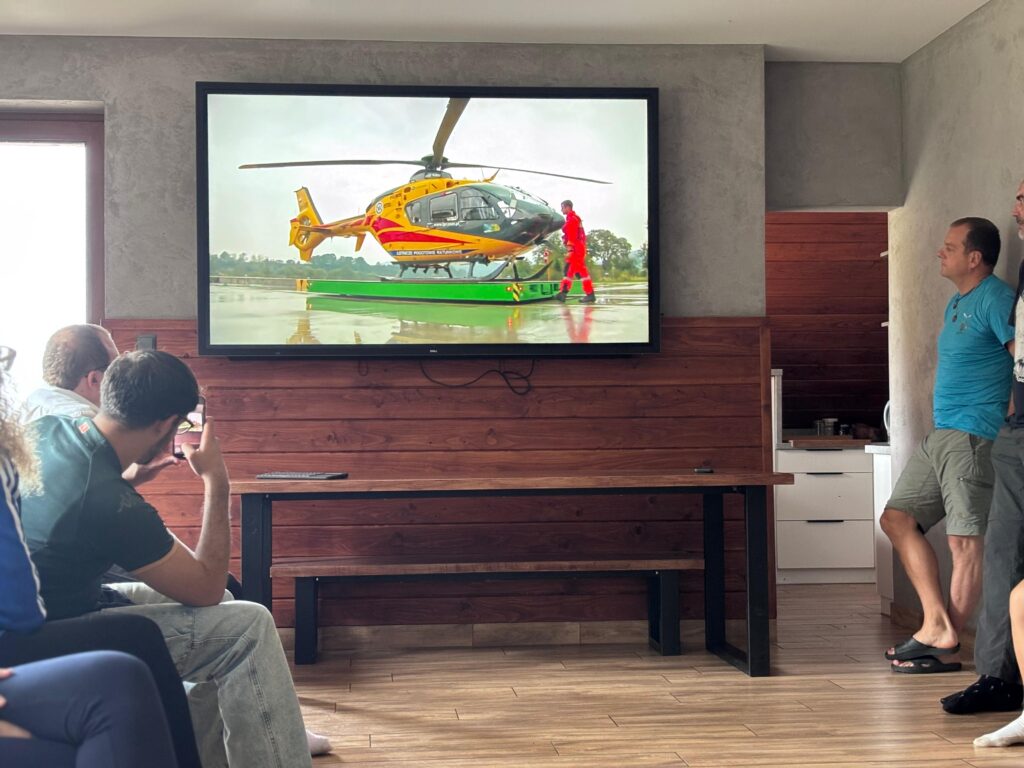
On the third day of the workshops, we left the training room and walked into the mountains. The hike to the GOPR station (Mountain Volunteer Search and Rescue) became a way of learning. Along the way, participants encountered practical preparedness tasks and reflections around the themes of uncertainty, evacuation, hazard zones, and psychological first aid. Our group had a chance to witness the mountain rescuers who deal with emergencies as part of their everyday reality.
We explored what rescue, non-governmental organisations do, how emergency procedures work and what happens when preparedness becomes a matter of real responsibility. After every station, each participant highlighted something on a dragon card: a thought, a question, a wisdom worth carrying forward. Later, those cards were shuffled and exchanged between groups, so someone’s individual reflection became another person’s material for discussion.
This was an important metaphor for the whole training:
“Preparedness grows when we carry not only our own knowledge, but something we have received from others.”
The emerging model therefore placed crisis competence alongside self-regulation and co-regulation: IN ACTION
Do I know what to do, and how to do it? This includes first aid, risk assessment, prioritisation, decision-making under pressure, evacuation and shelter, but also the ability to adapt when circumstances change. The model explicitly treats plan failure as an expected condition rather than an exception.
Preparedness became relational.
Then the focus shifted again. We came to an idea that trust cannot simply be switched on when a crisis begins. And that cultural sensitivity becomes especially important when people who have very different experiences of crisis are suddenly expected to act together.
This gave us another question: WITH OTHERS
How can I act with others under pressure? The competence model describes relational capacity as the ability to communicate clearly under pressure, listen when it is difficult, build trust before a crisis, work across differences, support vulnerable groups, distribute roles and sustain collective action.
Then we zoomed out.
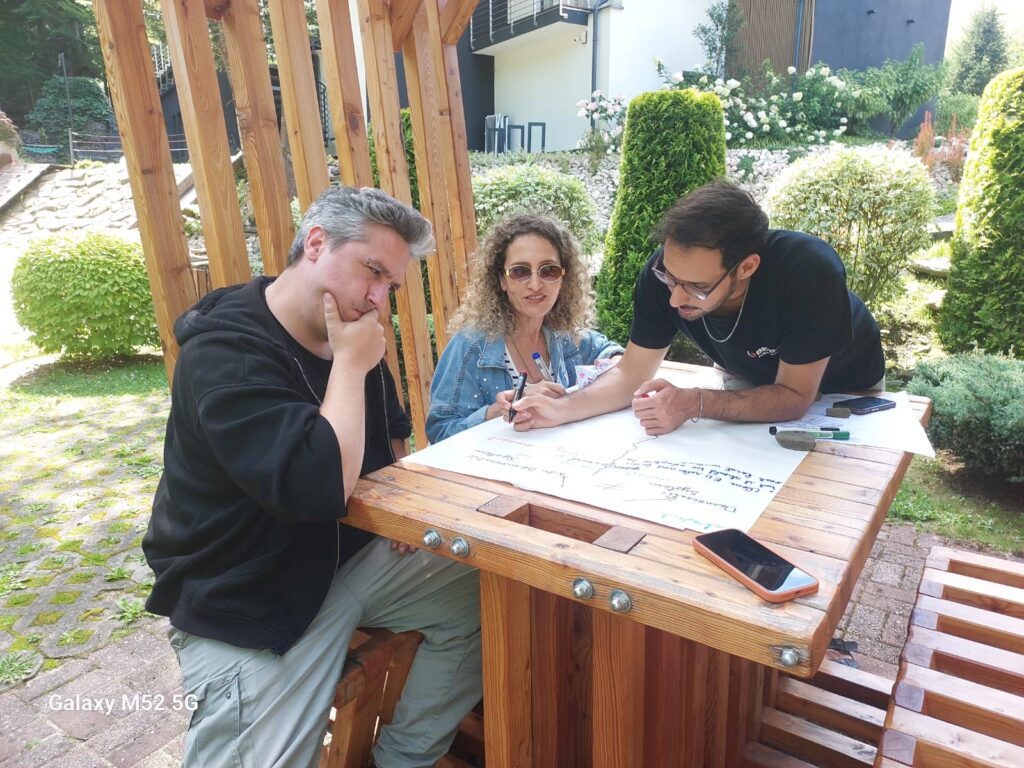
On the fourth day of the workshops, the Warm Data Lab, inspired by Nora Bateson, invited participants to look at preparedness through different contextual lenses. Instead of searching immediately for one correct answer, we moved between perspectives and noticed how the meaning of a question changes when the context changes.
This was particularly relevant to an international group. Preparedness in one country cannot simply be copied into another. People do not have equal access to information, infrastructure, institutional support, emergency services or community resources. People also carry different histories. For some participants, a crisis was an abstract possibility. For others, it was part of everyday life.
This led to another dimension: IN THE SYSTEM
Do I see and know the bigger picture? Here preparedness became connected with early warning, reliable information, institutional roles, the EU Preparedness Union Strategy, the context, community resources and the continuous relationship between mitigation, preparedness, response and recovery.
And then came the Princess
On the final day of the workshops, we brought the learning together through a simulation game: The King’s Watch. It was playful on the surface, but underneath it asked a serious question: Do we understand preparedness as something that happens before the crisis, or as a continuous cycle?
The game allowed participants to move through the four stages: MITIGATION, PREPAREDNESS, RESPONSE, RECOVERY, rather than treating a crisis as one isolated moment.
This became particularly important because the model itself argues that these stages overlap and feed into one another: recovery from one event can become preparation for the next. The princess did not simply need to be “saved”. The group had to think about what could have been done before, what was needed during, and what would matter afterwards. And perhaps this was the final reminder of the week
“Preparedness is not a moment. It is a cycle.“
The last day finished with compiling the full Competence Model, considering all contributions, experiences of the participants and reflections. The live experience, communication, contexts, abilities, perceptions and visions came together to formulate the new version of the Model. And it helped all of us to plan what to do next when we are back home in our communities.
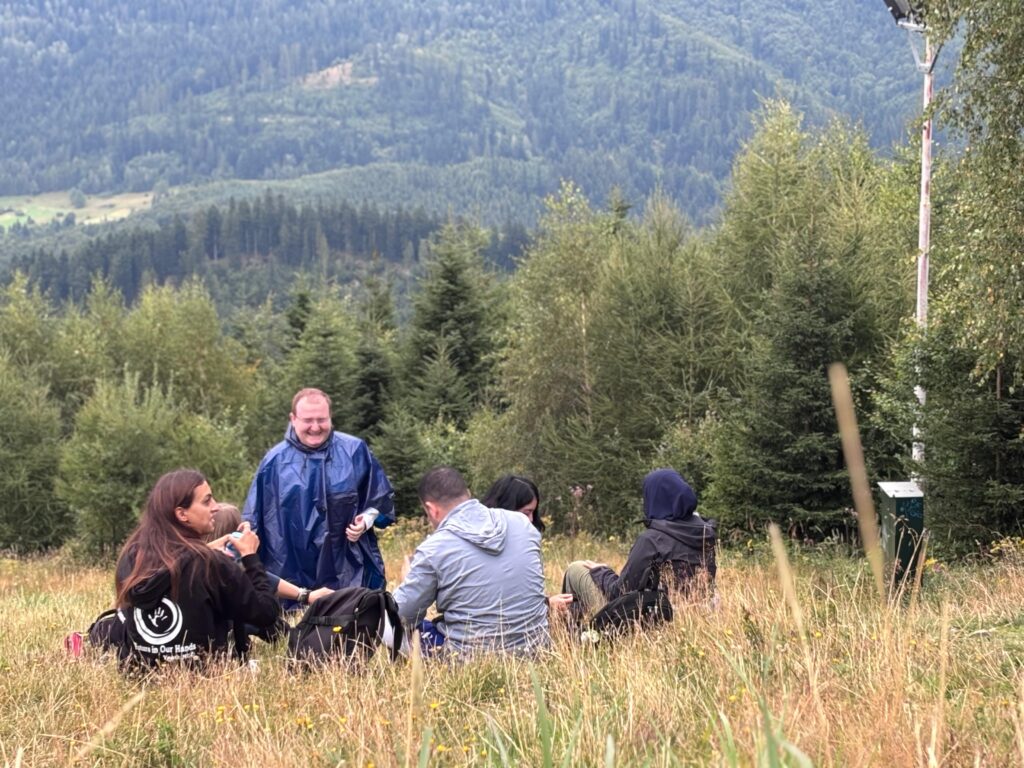
The Care Kit became a physical and symbolic collection of these resources: practices, questions, insights, relationships and actions that could be taken back into local contexts. And this is where the five days came together. We had started with two dragons. We ended up with a care kit for walking with them.
What started as a training became something else
The training was designed to develop trainers’ skills. But over the five days, something else happened. The group did not simply learn about a competence model. The group became part of its development. The draft model came into the room. Activities tested it. Different realities challenged it. Participants questioned its language. New connections appeared. Some concepts became clearer. Others needed to be reconsidered. By the end, we were no longer looking at a model that belonged only to its original authors. We were looking at a shared language of preparedness.
Building the Competence Model together
From a draft to a shared language
A competence model can provide structure to something that otherwise feels overwhelming. Preparedness contains many different elements: stress regulation, first aid, decision-making, communication, relationships, information, systems and recovery. Without a framework, these can remain separate pieces. The model helped us ask a different question:
- What does a person need to be capable of when uncertainty becomes real?
- What am I already capable of, and which skills do I need to practise and discover?
- What is my community (system) capable of and what role am I willing to take?
The first draft of the competence model was elaborated by the trainers, based on materials developed by the European Commission and communities of practice in youth work, to set the tone for the group work; it was a first attempt to dive into the topic, and this model was intended to be discussed, tested, experienced from within and in the group and used as a basis for reflection and transfer.
The whole training was split into 4 parts of the Competence Model, which we experienced during 5 days; some aspects were interlaced, showing that it’s not just one part of the Competence that can be developed on its own, but everything is interconnected – to be able to act in the crisis, we need to know how to regulate ourselves to be able to build trust in the community, which takes effort, time, interpersonal skills, knowledge and resources about the communities.
The model met the dragons
The dragons helped make the abstract competence Inside of Me tangible. Instead of simply saying “self-regulation”, participants experienced uncertainty through movement, body awareness, imagination and reflection.
We encountered the uncertainty
Blindfolded walks with few instructions, hazard zone protocol discussions, evacuation essentials and haste, and improvisation activities challenged the assumption that preparedness equals planning.
The model had to hold both: prepare carefully and be ready to adapt when preparation is no longer enough.
This connects directly to the model’s formulation that plan failure should be treated as an expected condition.
Context changed the answer
The international group revealed that preparedness cannot be separated from context. A strategy available to one organisation or country may be unrealistic somewhere else. That strengthened the importance of contextual thinking, multiple perspectives and cultural sensitivity in In the System and With Others.
The model therefore did not become stronger by becoming more fixed. It became more powerful by becoming more questionable. Every question, statement and reflection from a participant created an opportunity to see something differently. Every different context challenged the idea that there could be one universal answer. Every activity showed us something that could not have been discovered through discussion alone
This model belongs to everyone who interacted with it.
| For any questions and reactions, please contact: anna.hryshkevich@frse.org.pl and tomasz.szopa@frse.org.pl React and share your opinions with the community. Comment our FB post. |